Breaking News


Enter your email address below and subscribe to our newsletter

All voices matter
Glass, fragile and transparent, becomes fire, memory, and protest in the hands of an artist who has made this material his language.
For more than thirty years, Jaime Guerrero has transformed breath and heat into stories of migration, injustice, and hope. Born in Los Angeles in 1974, son of parents from Zacatecas, Guerrero has achieved something uncommon: giving a voice to the invisible through an art form usually associated with beauty, not pain.
His story did not begin with a clear vocation, but with a search. When he enrolled at the California College of Arts and Crafts, in Northern California, he thought he would dedicate himself to sculpture or painting. “I had never been exposed to blown glass until I got there,” he recalls.
But in his second year, he saw for the first time how fire and air shaped matter, and everything changed: “I decided that this was what I wanted to do for the rest of my life.”
Paradoxically, his degree was not in glass, but in sculpture. “I didn’t get along with my teacher,” he admits. “To continue working with glass without having to take more classes with him, I changed my major. That gave me the freedom to explore glass on my own.” In that process, he also studied ceramics and painting, which broadened his vision and allowed him to mix techniques and materials without limits.
Since then, glass became his focus and his voice. Over three decades, he has experimented with forms, colors, and scales, but in recent years his work has taken on a more urgent and committed tone. “Now I am very inspired to represent the Latino community,” he says, “to talk about our efforts, our problems, and what we face.”
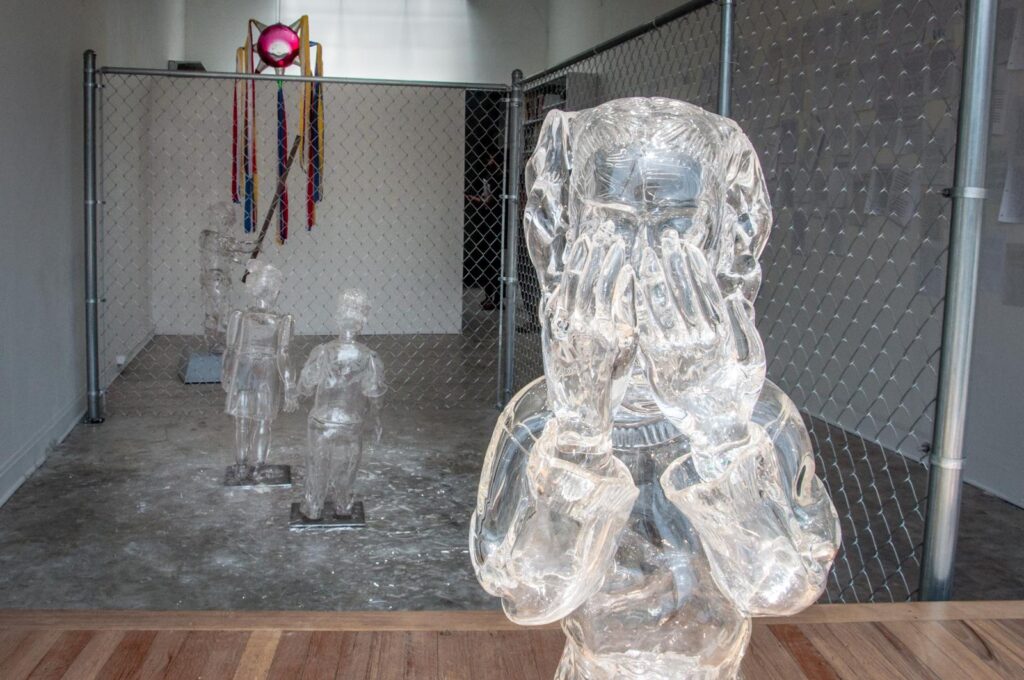
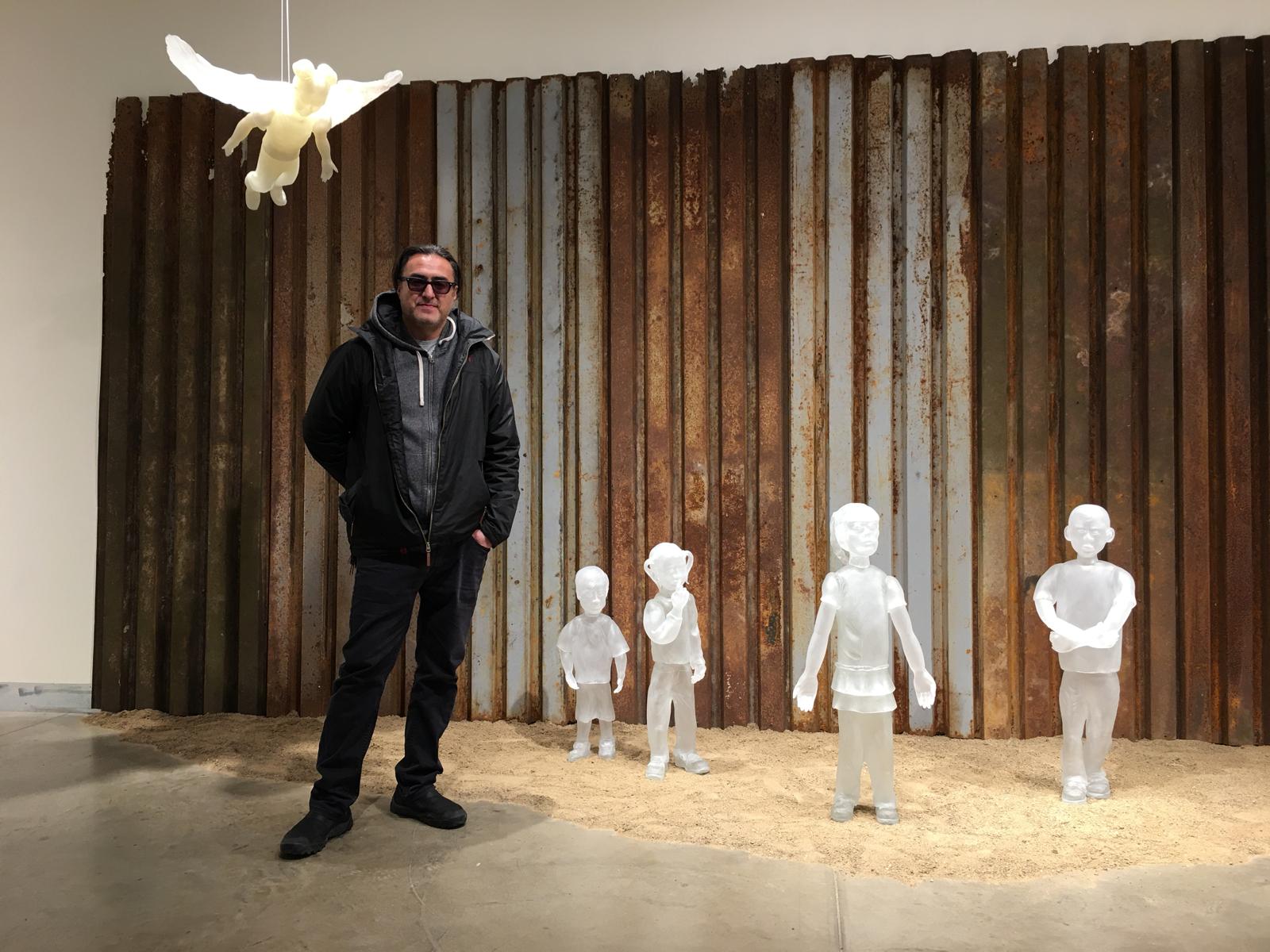
During Donald Trump’s administration, that inspiration turned into a visual shout. Guerrero created an installation at the Pittsburgh Glass Center that addressed the separation of immigrant families at the border. “It was something inhuman,” he explains. The work included a wall that symbolized the border and transparent figures of children in front of it, like souls caught between two worlds. “They represented the invisible stories of those children.”
The project was not a product of imagination, but of testimony. The artist interviewed a hundred migrant minors: he asked them why they had come, what they had suffered on their journey, and what they dreamed of upon arriving in the United States. “Those stories were the foundation of my work,” he affirms.
One of the most powerful sculptures was Yanira, a six-year-old girl separated from her mother. The piece, inspired by a real photo, included audio with the little girl’s crying and the jeers of the immigration agents. “I wanted to reflect on the cruelty of the situation.” The exhibition received great attention: it was highlighted by the Pittsburgh Post-Gazette as one of the ten best of the year in western Pennsylvania and was attended by the governor at its inauguration.
Beyond the recognition, Guerrero saw in that work a form of resistance. “I felt the responsibility to speak about these injustices and to give voice to the children who could not be heard.” For him, art is not just contemplation; it is action.
That same ethic guides his community work. He works with organizations like Latino Community Center, Casa San José, and Art Excursions, in Hazelwood, where he teaches young people the basics of glassblowing. “I believe that every artist has the responsibility to give something back to the community,” he states. “If you have a skill, you must share it with those who need it.”
His teaching begins with the essentials: blowing, heat, material control. Students learn to create a glass, the foundation of everything in this art. Then they move on to more complex pieces — vases, plates, hearts, or pumpkins — which they can sell or use as a source of income.
“This way they can sustain themselves, or even work as assistants or teachers at the Pittsburgh Glass Center. Some help me with my sculptures, and I pay them for their work.”
Guerrero does not forget his own origins. “I grew up in an area with a lot of poverty, violence, gangs, and police brutality,” he recalls. “That is why I want to help communities that face the same things.” His vision of art as a social tool has made him a mentor and a reference for young people who find in glass a different path.
The artist also acknowledges the decisive influence of Pino Signoretto, an Italian master of glass and a legend in the world of sculpture. “When I saw him work, I understood that everything I had learned in four years was nothing compared to his technique. I took classes with him several times and learned the essentials.” Over time, he developed his own style, without losing respect for the tradition and mastery of the craft.
Today his gaze is set on the future. “I am focused on setting up my workshop, equipping it, and connecting it with different organizations to give classes,” he comments. His plan includes bringing students from Los Angeles of the program he founded at the Watts Labor Community Action Committee (WLCAC) to Pittsburgh. “They already work with glass and sell their pieces. I want them to come to teach and help produce pieces.”
His goal is not just to create, but to build bridges. “I want to focus on works that talk about current social problems, from a humanitarian perspective, not a political one.” That distinction — humanitarian, not political — defines his art: Guerrero does not seek propaganda, but empathy.
And although migration issues remain present, he does not address them out of trendiness or anger, but out of conviction. “Today the same thing keeps happening: immigrants continue to be demonized. ICE is arresting people without due process. These are inhuman and illegal practices, and I want to talk about that in my art, even though I still don’t know exactly how I will represent it.”
His art is a form of silent resistance, a mirror that forces reflection. In a time of borders and hate speech, Guerrero chooses glass, a material as transparent as it is vulnerable, to speak about what is preferred to be ignored.
At the end of the interview, his reflection sounds more human than artistic: “I don’t have all the answers. I only know that I am a blown glass artist; that is what I have decided to dedicate my life to and what I can offer. I share what I know with anyone who wants to learn.”
Among furnaces and torches, among sculptures that cry and children made of light, Jaime Guerrero demonstrates that art can be an act of resistance, a prayer, and a bridge. “We live in very dark times,” he says, “full of injustices, but we must help each other and keep moving forward, always seeking the light within what is possible.”