Breaking News



Enter your email address below and subscribe to our newsletter

All voices matter
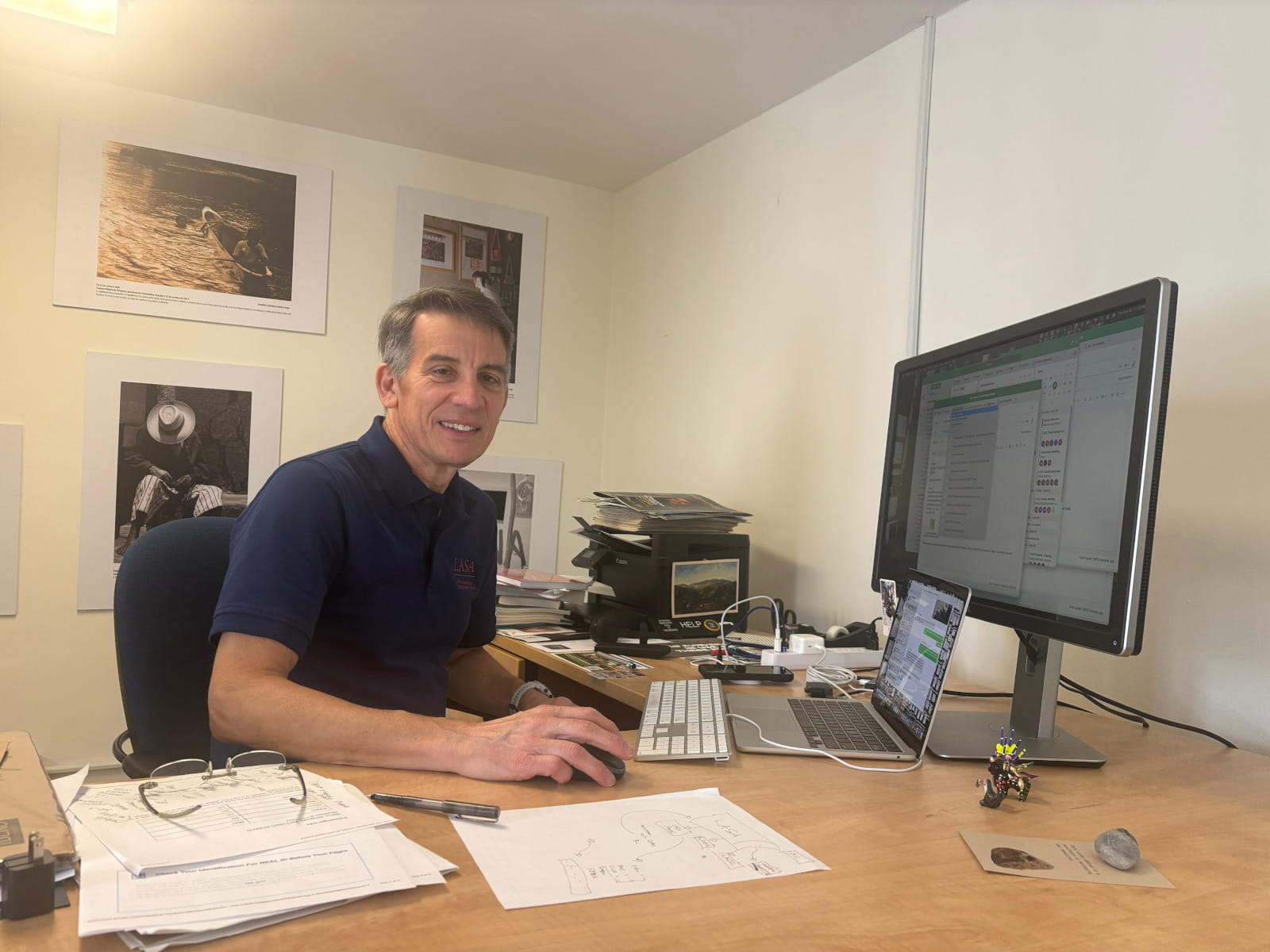
There are those who build their life in one place and there are those, like Manuel Román Lacayo, who trace it in constant movement. «I have counted 44 moves since I was born: some prompted by natural disasters like earthquakes, others by wars or social conflicts, and many more by my search for learning and growth,» he confesses. That number sums up an existence marked by mobility, but also by a profound ability to adapt. Although he longs for roots, the stability of a fixed home, he has learned to recognize that each move brings with it a new opportunity for growth. «Although I yearn for a permanent home, I also enjoy the possibility of feeling at home anywhere,» he summarizes calmly. Today, from Pittsburgh, he holds the position of deputy director of the Latin American Studies Association (LASA), but his biography, like his discipline, cannot be read without excavations: layers of experiences, cultural roots, and memories that weave into his identity.
When he talks about what he misses most about Nicaragua, he does so with a sparkle in his eyes. ‘What I miss the most is the people, that way of relating, the friendships that remain despite the passage of time. I can return decades later and there they are, intact.’ It’s not just about people, but also about everyday gestures and the soundscape of the streets: street vendors offering güirilas or buñuelos, the funeral car with a loudspeaker going through neighborhoods. «A good quesillo, a rellena at the tiangue in Masaya, a ginger chicha… These are details I don’t need to live, but they are essential for identity,» he states. The climate is another cherished memory. Although he has adapted to the cold of Boston or Pittsburgh — «being in a heated house, being able to see the snow falling outside the window, that is nice» — his memory always transports him back to the Laguna de Apoyo. «At my father’s property, surrounded by trees and with the howler monkeys making noise in the rain, we spent our weekends. Those winter mornings are among the things I always carry within me.»
The curious thing is that archaeology was not his first choice. «I aspired to be an electronic engineer, but I faced many challenges with the theory… in the end, I found my path in archaeology.» This change led him to Harvard, where he studied Social Sciences, and then to the University of Pittsburgh, where he earned his doctorate thanks to the Heinz Foundation. In Masaya, he conducted his doctoral research, focused on the municipalities of Tisma and Ticuantepe. There, he studied communal structures and the phenomenon of caciquismo: an intermediate system between tribe and state where political power is inherited. «My background is anthropological: I use archaeology as a technique to understand extinct societies that left no writing, but did leave material culture,» he explains.
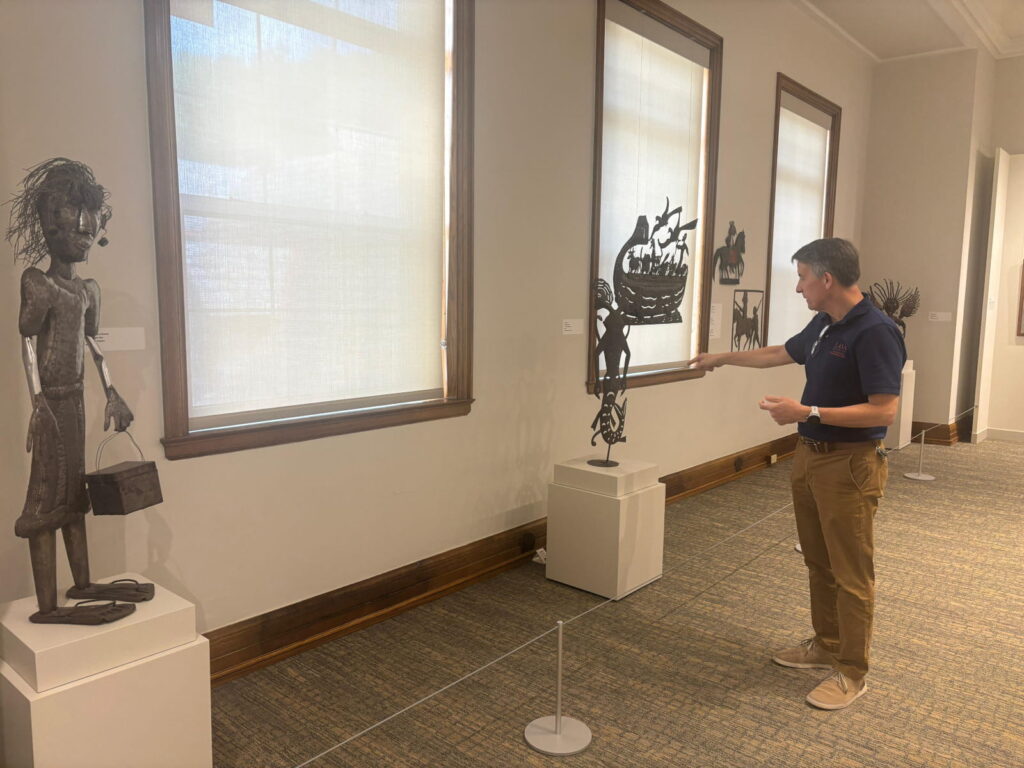
Other cultural and artistic expressions carved in metal that Manuel Román Lacayo exhibits at the Latin American Cultural Center are allegorical sculptures related to the supernatural world of Haitian Voudou. Photo: Courtesy This academic approach was complemented by professional practice. He was the director of the National Museum of Nicaragua from 1998 to 1999 and founded the master’s program in Latin American Studies at the American University of Managua.

His career also took him into the field of development and management of international projects. He worked in Guatemala on public-private partnership programs that multiplied social investment in health, education, nutrition, and disaster mitigation. In Panama, he participated in environmental monitoring of the expansion of the Canal.
In various countries, he coordinated infrastructure projects, solar energy, oil pipelines, and roads. «The principle was not to leave something worse, but to leave it the same or better, both for the environment and for the social environment,» he emphasizes. This philosophy turned him into a bridge between companies, local communities, and multilateral organizations, ensuring that the impacts of the projects did not erase identities or the lives of the populations.
He even worked in Angola, applying his knowledge of cultural heritage and the environment in an African context. This diversity of experiences solidified his ability to understand archaeology not only as a study of the past but as a tool to tackle the challenges of the present.
While Pittsburgh was not the destination I dreamed of, it ended up being an unexpected point of attachment. There, I completed my doctorate and discovered a vibrant academic community in Latin American studies. Since 1986, LASA’s headquarters have been in that city thanks to the support of the University of Pittsburgh. In 2019, the association acquired a historic 113-year-old building that was remodeled and converted into the Latin American Cultural Center. «Our work is to bring together specialists and meet to present, discuss, and communicate ideas about Latin America, in fields ranging from politics and literature to art, theater, or music,» explains Manuel.
Today, LASA has 13,000 members worldwide and organizes international congresses that gather thousands of researchers. In recent years, these have been held in Bogotá, San Francisco, and Vancouver; soon in Paris, and later in various Latin American cities due to entry restrictions to the United States.
The Latin American Cultural Center directed by Manuel Román Lacayo in the city of Pittsburgh, Pennsylvania, United States, presented an impressive exhibition called Haiti: Culture, Religion, and Revolution. Photo: Courtesy The Cultural Center that she directs along with her team offers three exhibition halls: one dedicated to the geography and biodiversity of the continent, another focused on cultural and artistic expressions, and a gallery for temporary exhibits. In 2024 it was dedicated to Haiti; in 2025 it will be dedicated to Costa Rica and in 2026 to Panama.
The vital map of Manuel Román Lacayo connects geographies, languages, and memories. Managua, Diriomito, Cambridge, Boston, Washington, Pittsburgh; museums, universities, infrastructure projects, and international conferences: each space has left a mark. However, beyond the titles and positions, the longing for his homeland persists, along with the conviction that identity is also built from a distance.
The paradox of his life is captured in a phrase that defines him: «Although I long for a permanent home, I also enjoy the possibility of feeling at home anywhere. In that confession lies the archaeology of his own existence: a constant excavation between the past and the present, between rootedness and movement, between memory and projection towards the future.

Earn recurring commissions with each referral—enroll today!
Your audience, your profits—become an affiliate today!
Start earning on autopilot—become our affiliate partner!
Get paid for every click—join our affiliate network now!
Heard some good stuff about ijjgame. Figured I’d give it a shot. Interface is smooth. Gameplay’s decent. Hope to win some real cash! Peep it ijjgame
Signed up for 888winlogin. The login process was quick and easy. Hopefully the games are just as smooth. Let’s get this bread! Give it a looksee 888winlogin
Downloaded the 8casinobetapp. Initial impression? Not bad! Graphics look good, games seem varied. Hope my luck is on point tonight. Give it a try 8casinobetapp
Join our affiliate program today and earn generous commissions!
Gave 65bet1 a whirl. Found the layout easy to navigate, a real plus. Worth a look if you’re after a user-friendly platform. 65bet1
777vipp… Hmm, the user interface impressed me. Feels a little premium. Might be worth a look folks. 777vipp
Signed up on bet23login. Registration was straightforward, which is always a plus. Give it a try if you want fuss-free access. bet23login
Become our affiliate—tap into unlimited earning potential!
Refer and earn up to 50% commission—join now!
Partner with us and earn recurring commissions—join the affiliate program!
Join our affiliate community and maximize your profits!